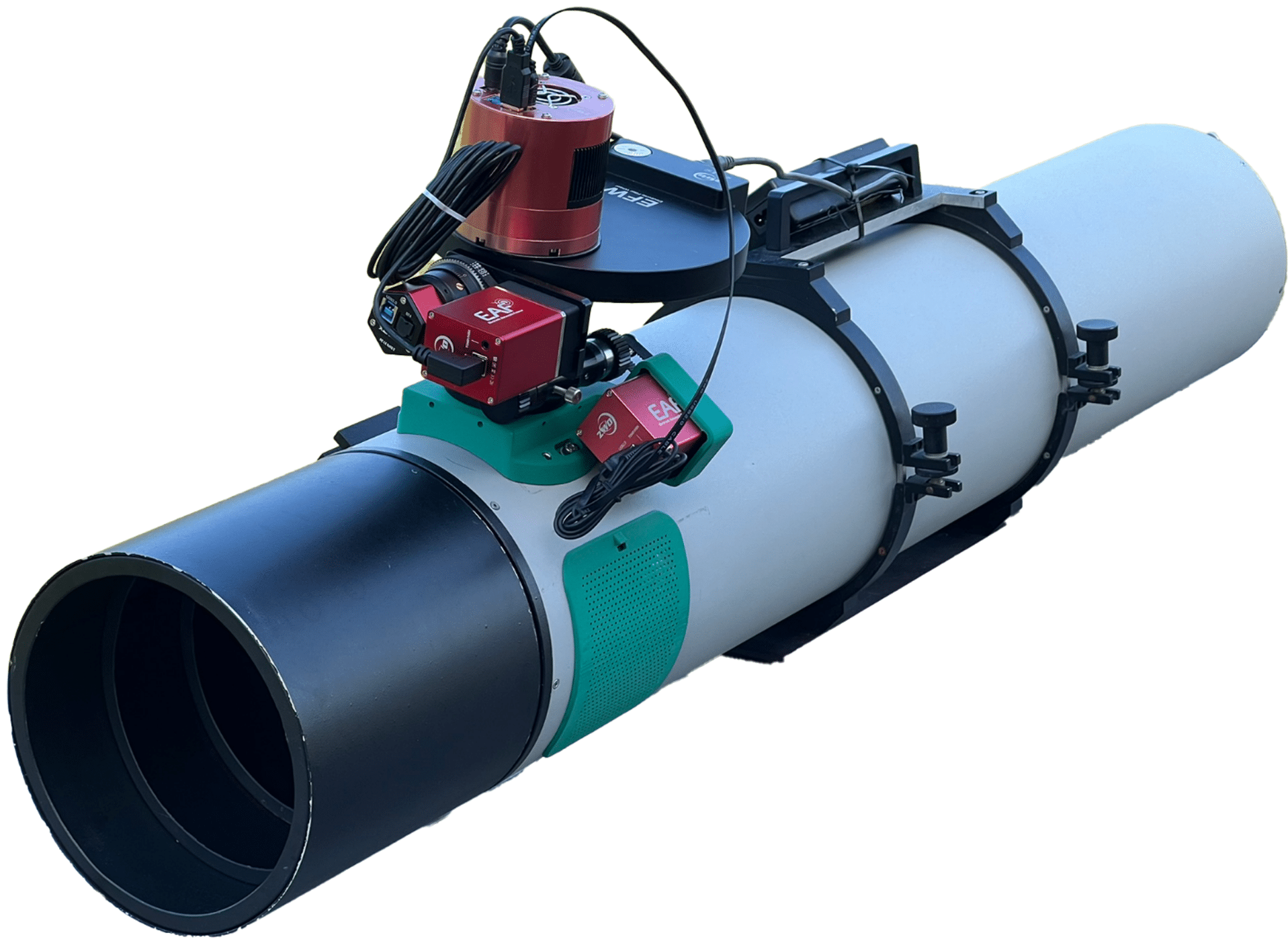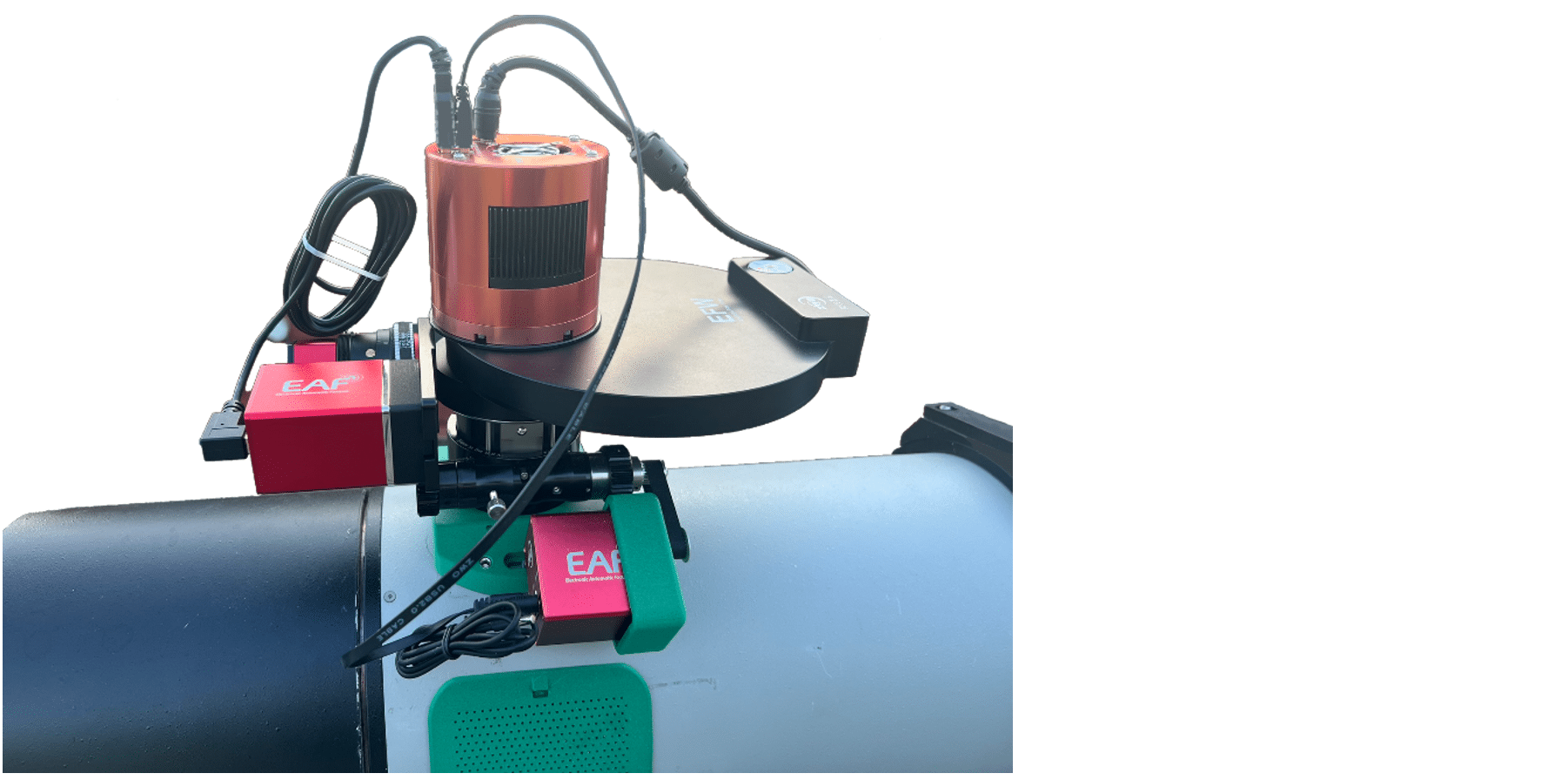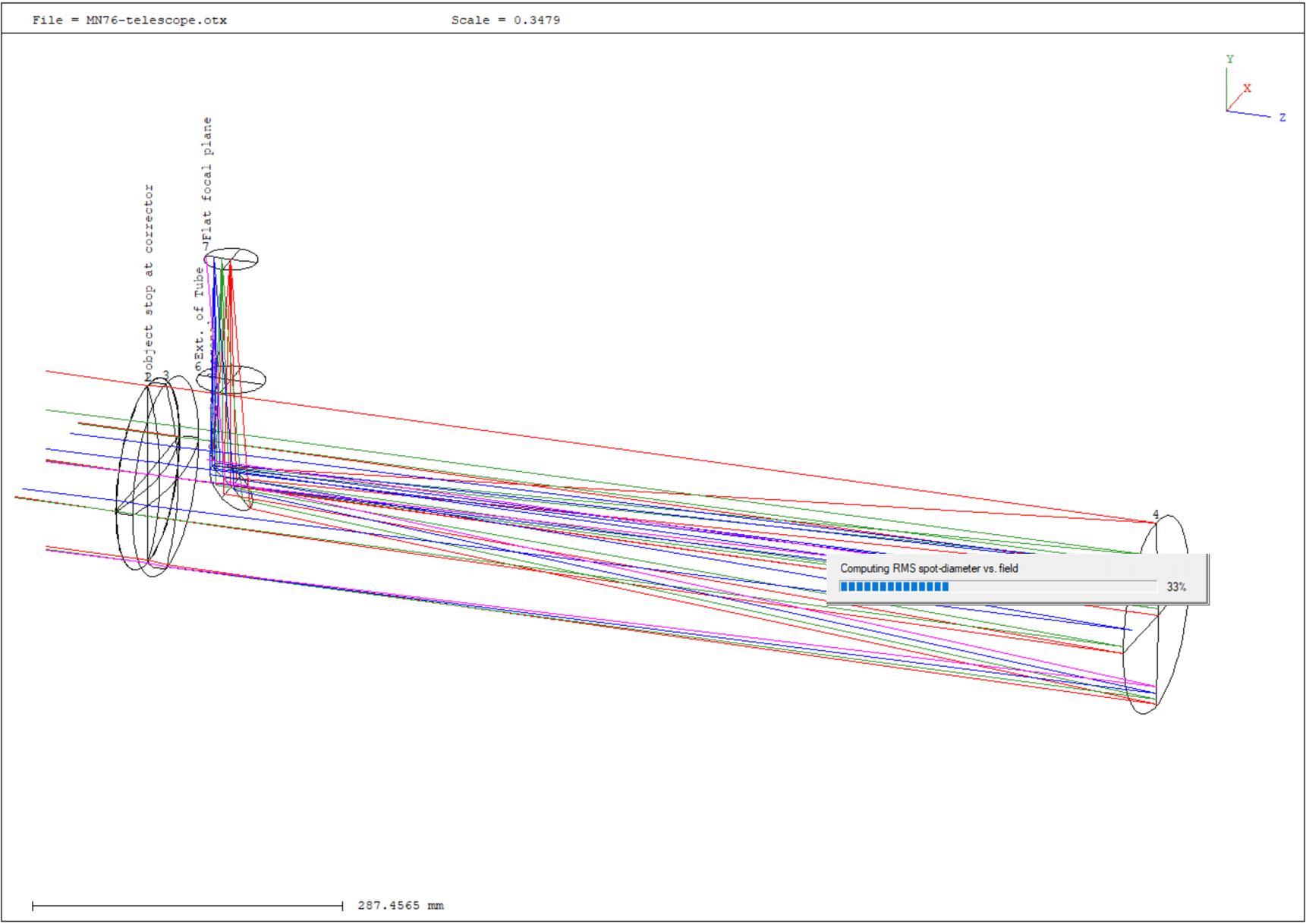
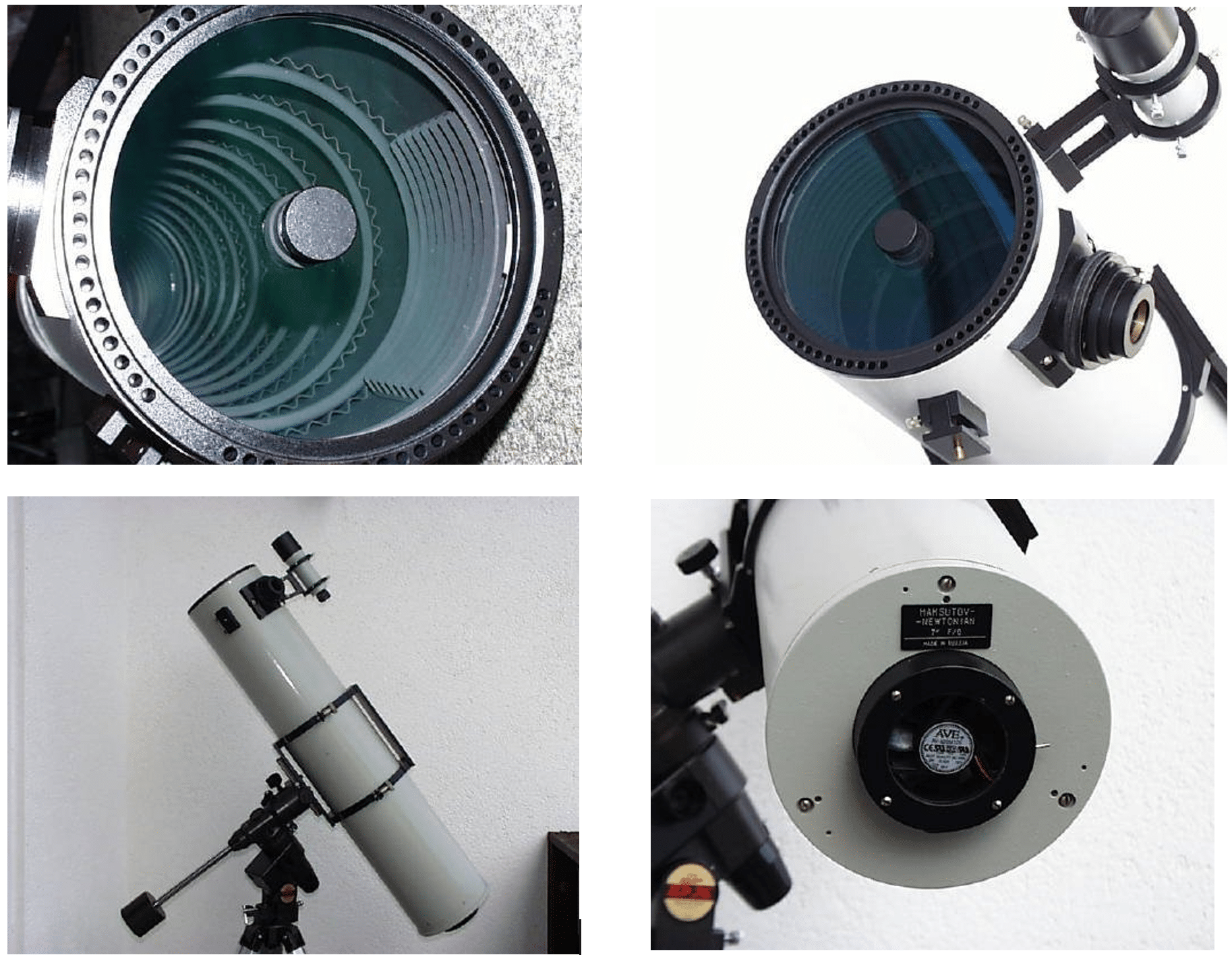


The optical prescription for the MN76 was published by the manufacturer, omitting details about the corrector. Only the corrector plate needed to be reverse-engineered, along with confirming some of the manufacturer’s given dimensions. Corrector ROC values were obtained by crude profilometry using a machine tool equipped with DRO’s and a dial gauge.


The MN76 was an F6 instrument. Tube length was only 106 cm, extending to 127cm after adding the dewcap/light baffle, which is essential.
The standard instrument delivers a tiny fully illuminated field (3mm diameter at the image plane) equipped with the standard diagonal mirror, giving exquisite high magnification lunar/planetary images, used visually or with a planetary camera. Obscuration is around 21%, there is no spider vane diffraction and light baffling is superb. Hence the reputation for ‘refractor-like’ views.
The 180mm aperture stop is located at the corrector meniscus, and this, together with the slow optics, small diagonal and only 8mm oversized primary mirror, has the effect of limiting the extent of off-axis aberration. Best image surface radius is aound 4000mm, concave towards the primary. In other words, field curvature is not noticeable visually or with small chip cameras.


It is important in Mak’s used for high resolution imaging that the corrector be accurately centred and squared to the optical axis. In a relatively slow medium aperture F6 instrument, corrector decentration should not exceed 0.5mm, while corrector tilt error should not exceed 0.5 degrees to the reference axis through primary mirror and corrector cell aperture. The effect of combined decentration and tilt is easily modelled using lens design software.
In the Intes-Micro instruments, these tolerances were managed by fitting the corrector cell closely to the ID of the tube, edging the corrector lens to a fairly close clearance fit into its cell, and then shimming and rotating the corrector to give a good test result in double-pass interferometry.
I suspect that the all-spherical surfaces involved, the high-quality polishing, not to mention the habitual high working standards of the people involved in the assembly process mean that most of the instruments produced use essentially identical components, that differ mainly in the efforts made to set up OTA’s for best performance.
Paper radial shims are inserted between the corrector and its mounting cell to control decentration. There is no explicit tilt adjustment provided, nor should this be necessary, given the simple mechanical design.
Note the filtered vent holes provided around the circumference. These are unlikely to be very effective at venting tube currents.

The primary mirror is spherical and simple to make to a high standard of irregularity and polish. The maker chooses to mask off the outer 2mm of the edge, which has the advantage of removing slight turned edge.
The mirror is supported radially and axially on three silicone rubber blocks, equally spaced around the circumference. This seems to work well. The primary is fixed with minimal strain, and accurately located on the C/L of the mechanical structure.
Tip/tilt screw pairs control mirror collimation. Stability is good in the face of vibration, aided by the use of shoulder screws to minimise lateral slip.
The mirrors are aluminised and SiO2 overcoated. For extended IR performance, protected silver coating can provide a substantial boost in reflective performance at IR wavelengths with minimal loss at visible wavelengths. (It may not be easy however to source a coater willing to coat small optics at a sensible cost, however)
What we see is a typical R&D-oriented instrument design, hand-made, costly to produce, with many components and some critical tolerances. The basis of the reputation for quality performance and optical stability is evident.